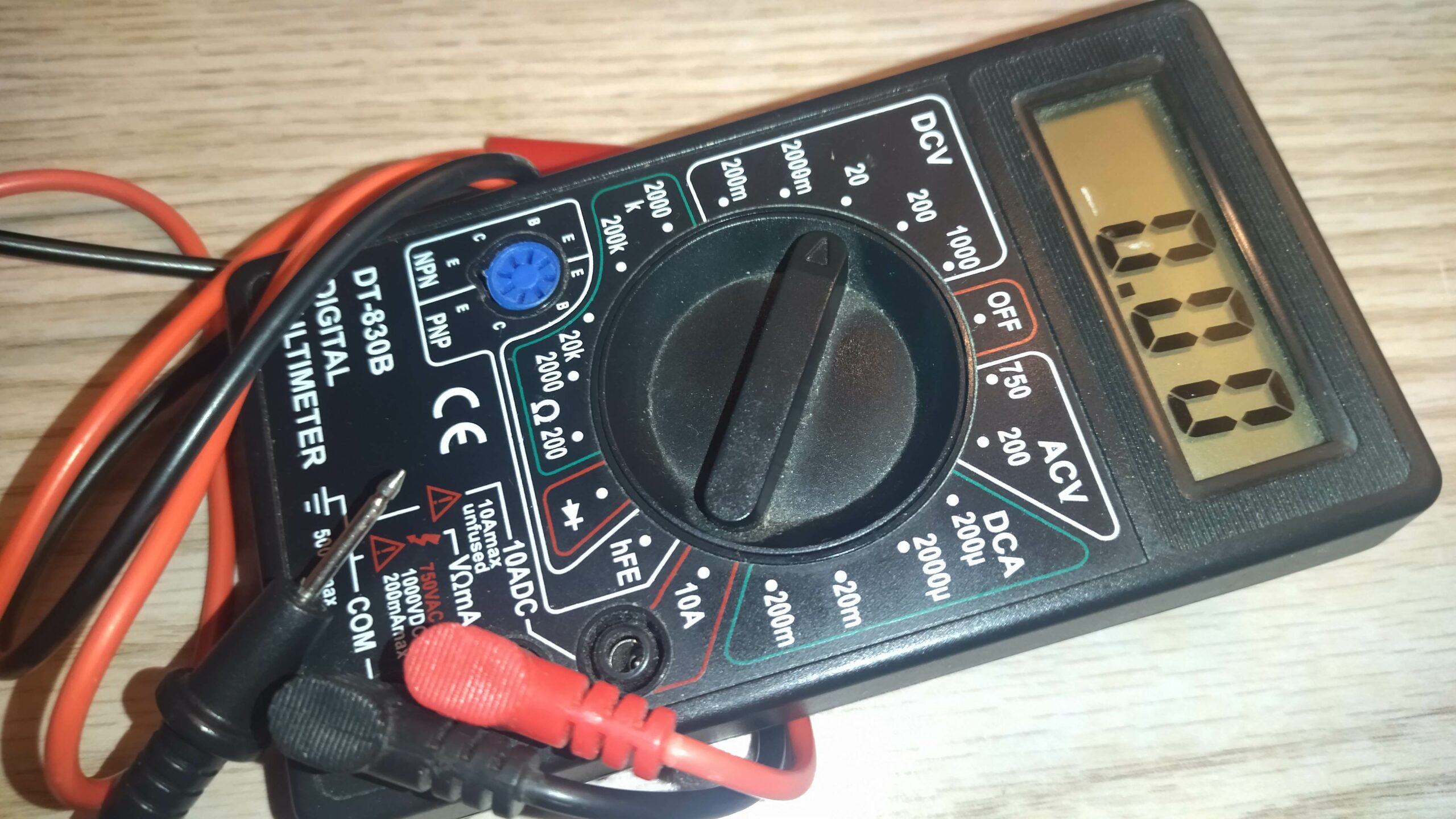
I own a cheap multimeter. It cost around $20.
And I have access to an Agilent 34401A.
Now, let’s be realistic. Nobody expects a $20 multimeter to outperform an Agilent. That would be ridiculous.
But does that mean we should simply accept that our cheap multimeters are inaccurate and live with it?
I decided to investigate.
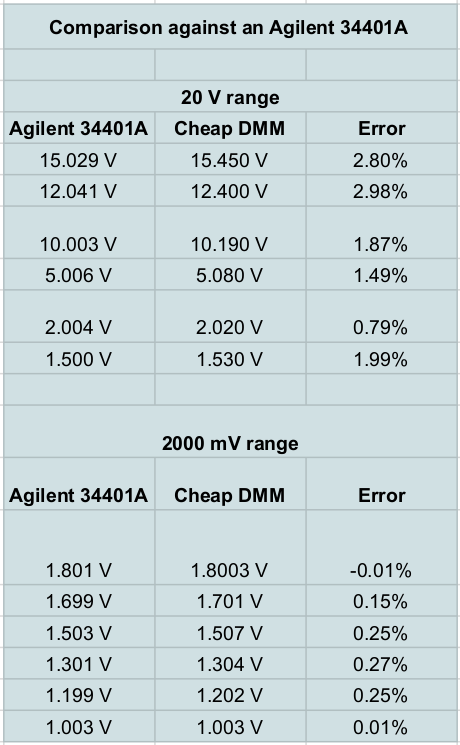
I connected both instruments to the same power supply and started taking measurements. Different voltages. Different measurement ranges. Recording the results.
And I discovered something interesting.
On the 20 V range, my cheap multimeter was almost 3% off at some voltages.
Not exactly reassuring.
But when I switched to the 2000 mV range, the results were considerably better.
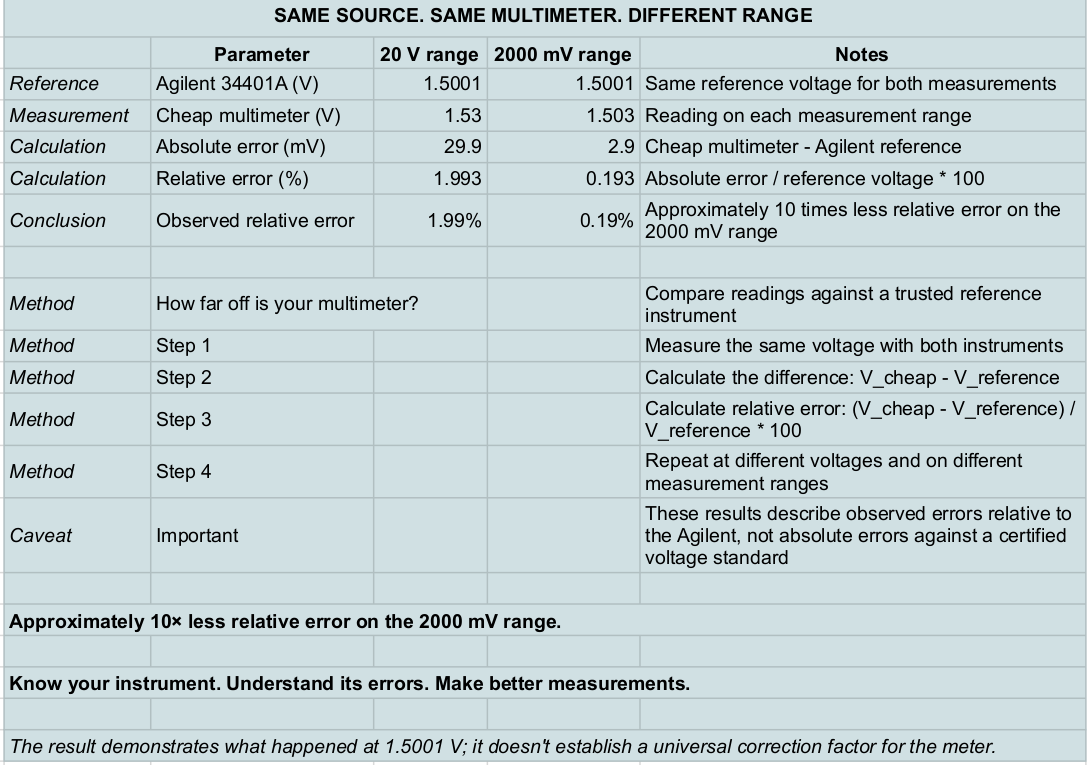
At approximately 1.5 V, the Agilent measured 1.5001 V.
My cheap multimeter?
– 20 V range: 1.530 V
– 2000 mV range: 1.503 V
Same voltage. Same multimeter. Different range. A very different result.
And that’s the point.
I don’t need to pretend my cheap multimeter is more accurate than it is. I need to understand where, when, and by how much it gets things wrong.
By comparing its readings against a trusted reference, I can map its errors and build a picture of its errors.
Instead of blindly trusting the displayed number, I can make an informed decision about what that number actually means.
And suddenly, those few digits on the display become a lot more useful.
Of course, there’s one condition: the errors must be sufficiently stable and repeatable for the corrections to remain valid. That’s something I still need to investigate, a different day, a different temperature, and a fresh battery.
But perhaps I don’t need a better multimeter just yet.
Perhaps I need to get to know the one I already have a little better.
Rebuilding trust, one measurement at a time.
And if it keeps making the same mistakes, we might just get along fine.