Description
One reference current. Three precision outputs.
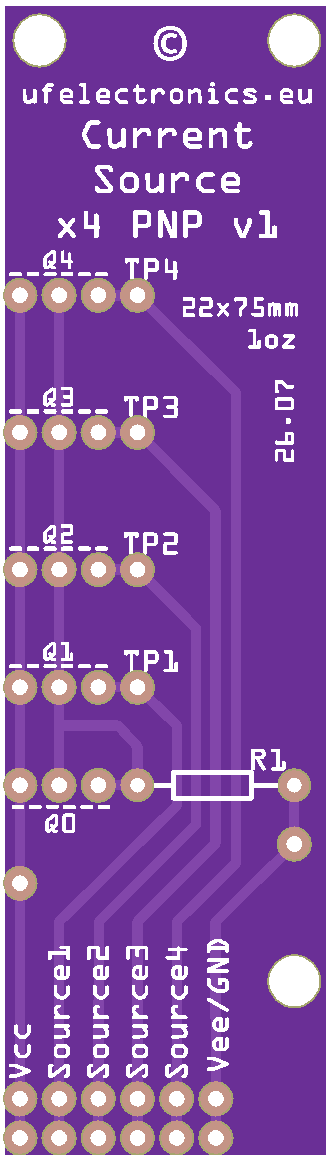
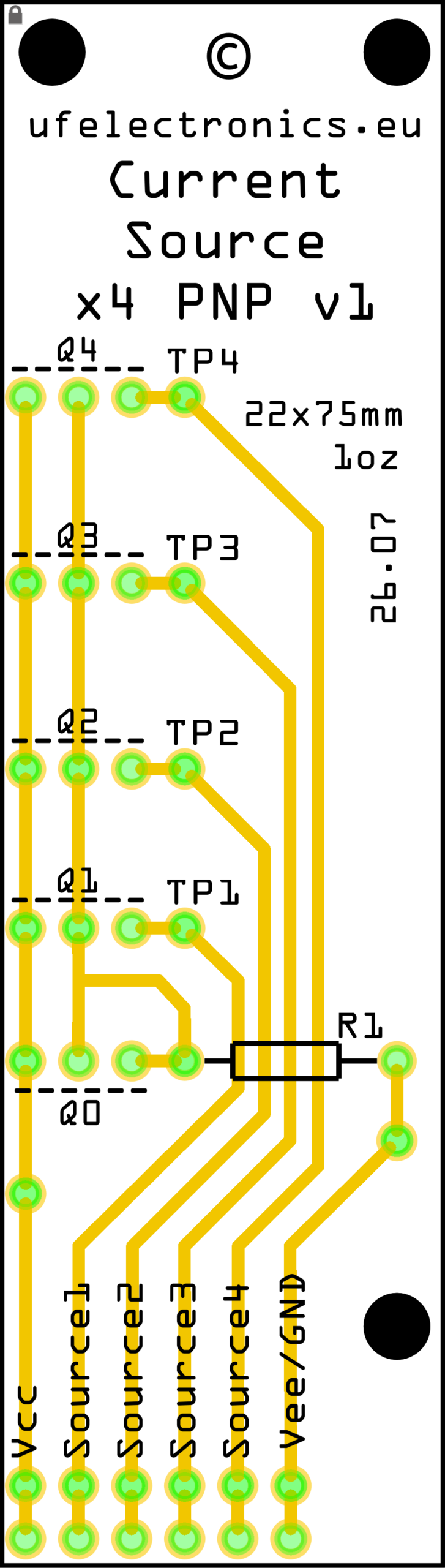
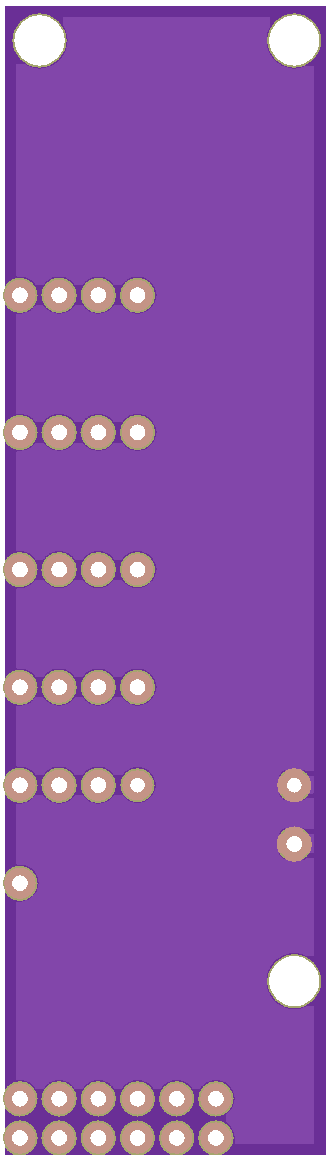
The Current Source Mirror Experimentation Board v1 is a compact educational PCB designed for learning and experimenting with transistor current mirrors.
Using four matched PNP transistors, the board generates a single reference current that is mirrored to three independent outputs. A programming resistor sets the reference current, while the remaining transistors reproduce nearly identical currents for use elsewhere in a circuit.
This simple concept forms the basis of many analogue integrated circuits. Current mirrors are widely used to bias amplifiers, differential pairs, active loads, voltage regulators and operational amplifiers because they provide stable, predictable currents that are largely independent of load resistance.
The board makes it easy to investigate how current mirrors work, how transistor matching affects accuracy, and why mirrored current sources are preferred over simple resistor biasing in precision analogue designs.
Features
- Four-transistor PNP current mirror
- One reference transistor
- Three mirrored current outputs
- Adjustable reference current using a single resistor
- Through-hole construction
- Compact educational design
- Easy to measure and compare all mirror outputs
- Ideal companion for differential amplifier experimentation boards
How It Works
One transistor establishes the reference current by means of a programming resistor.
The base and emitter of the remaining three transistors are connected to the reference transistor, causing each device to develop nearly the same base-emitter voltage.
Because matched transistors operated at the same VBE conduct nearly identical collector currents, each output transistor sources approximately the same current as the reference transistor.
One accurately established current can therefore supply several independent parts of a circuit simultaneously.
What Can You Build?
The board can be used in a wide range of analogue experiments and practical circuits, including:
- Multiple bias currents for transistor amplifiers
- Differential amplifier current sources
- Active collector loads
- Operational amplifier building blocks
- LED current sources
- Precision current distribution
- Sensor excitation circuits
- Constant-current laboratory experiments
- Multi-stage analogue amplifiers
Learn About
This board is ideal for exploring topics such as:
- Current mirrors
- Current sources
- Reference currents
- Current replication
- Transistor matching
- Base-emitter voltage (VBE)
- Collector current
- Output compliance
- Current sharing
- Temperature effects
- Early effect
- Analogue integrated circuit design
Why Multiple Outputs?
Many analogue circuits require several identical bias currents.
Instead of calculating and building several independent current sources, one accurately generated reference current can be copied multiple times using a current mirror.
This improves matching, reduces component count and ensures that different stages of a circuit operate under nearly identical conditions.
Modern integrated circuits often contain dozens—or even hundreds—of current mirrors operating on this same principle.
Typical Applications
Multiple-output current mirrors are commonly found in:
- Operational amplifiers
- Instrumentation amplifiers
- Analogue integrated circuits
- Active filters
- Voltage regulators
- Precision current references
- Differential amplifier stages
- Audio amplifiers
- Data acquisition systems
Ideal For
- Electronics beginners
- Engineering students
- Universities
- Technical colleges
- Makers
- Electronics hobbyists
- Teachers and educators
- Analogue circuit designers